Every trade has its toolkit, and in high-risk industries part of that toolkit is paper — the nationally recognised units of competency that prove you can do the dangerous parts of the job safely. Some tickets are site-specific, but a handful come up again and again across mining, construction, oil and gas and industrial work in WA. If you are building a career on the tools, these five are the ones we would put in every worker’s pocket.
1. Work safely at heights (RIIWHS204E)
Falls remain one of the biggest killers on Australian worksites, which is why heights competency is a standing requirement on almost every mine site and construction project. The unit covers harness fit and inspection, anchor points, fall-arrest versus restraint, and rescue planning — because a harness only saves you if someone can get you down.
2. Gas test atmospheres (MSMWHS217)
Before anyone enters a confined space, opens a vessel or works near a potential leak, someone has to prove the air is safe — and keep proving it. Gas testing is the ticket behind the permit: instrument checks, sampling technique, interpreting readings and knowing when to pull everyone out. It pairs naturally with confined space and permit units, and many of our clients book them together.
3. Provide First Aid (HLTAID011)
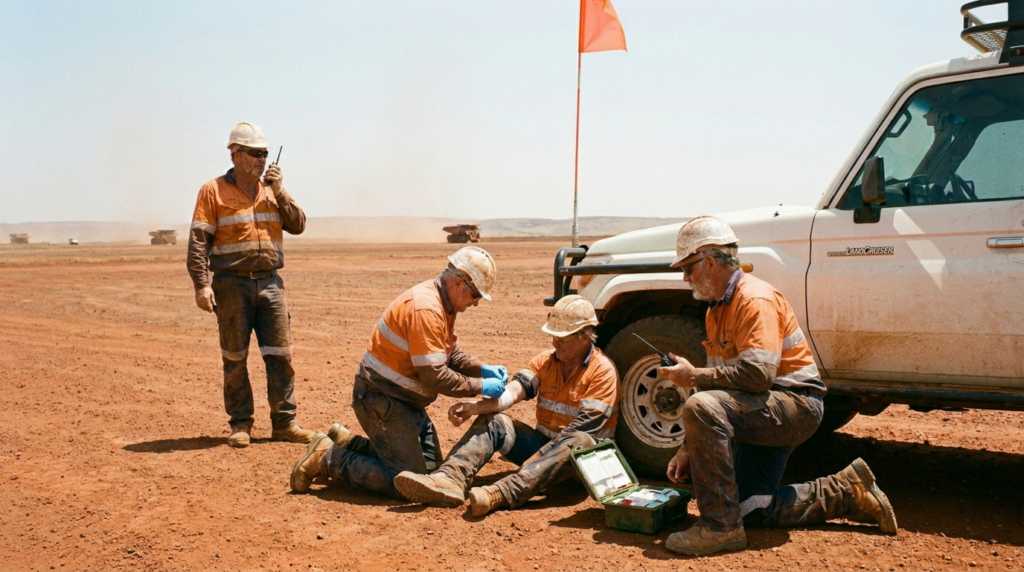
The most portable qualification on this list — it follows you across every industry and into daily life. The unit covers CPR, bleeding control, shock, burns and casualty management until help arrives. Working remote? HLTAID013 – Provide First Aid in remote or isolated sites extends the skill set for the long wait when the ambulance is hours, not minutes, away.
4. Operate breathing apparatus open circuit (PUAFIR207)
For emergency response team members, fire crews and anyone who might need to work in irrespirable atmospheres, BA competency is the gateway ticket. Expect real sets, real air management under exertion, and search-and-rescue drills in reduced visibility — it is a physical course, and it should be.
5. Operate and maintain a four wheel drive vehicle (RIIVEH305F)
More site work is being done further from the bitumen every year, and a 4WD is only as safe as its driver. This unit covers vehicle preparation, terrain assessment and controlled recovery. If your role involves emergency response driving, our combined RMTS Operational 4WD Response and Vehicle Recovery course adds PUAVEH001 for driving under operational conditions — one intensive day, two units.
Stacking your tickets
The right combination depends on your role: an ERT member leans toward BA, first aid and rescue units; a leading hand toward heights, gas testing and permits. If you are not sure what your site or your next employer expects, ask us — matching units to roles is what we do all day.
Ready to book? Check upcoming course dates at our Forrestdale facility or enrol online now. Group of five or more? On-site delivery usually works out better — here is how that works.